
April is Hashimoto's Awareness Month — and this one is personal. I'm not writing as a coach looking in from the outside. I'm writing as someone who lives this reality every single day. Hashimoto's hypothyroidism is often called an 'invisible illness,' and that invisibility is both its cruelty and its challenge. You look fine. But inside, your body is waging a war against itself.
My story: when the invisible became undeniable
For years, I pushed through. With 20 years of being an athlete and coaching experience at the highest level, I knew how to fight through fatigue, how to focus when my body screamed for rest. I thought it was normal. I thought everyone felt this tired.
Then came the diagnosis: Hashimoto's hypothyroidism. Suddenly, the puzzle pieces fell into place — the crushing fatigue that sleep couldn't fix, the brain fog that made simple decisions feel impossible, the weight that wouldn't budge no matter what I did, the mood swings that came from nowhere.
But here's what no one tells you about the diagnosis: it's both a relief and a beginning. Relief because you finally have a name for what you've been feeling. A beginning because now the real work starts.
The invisible illness: what people don't see
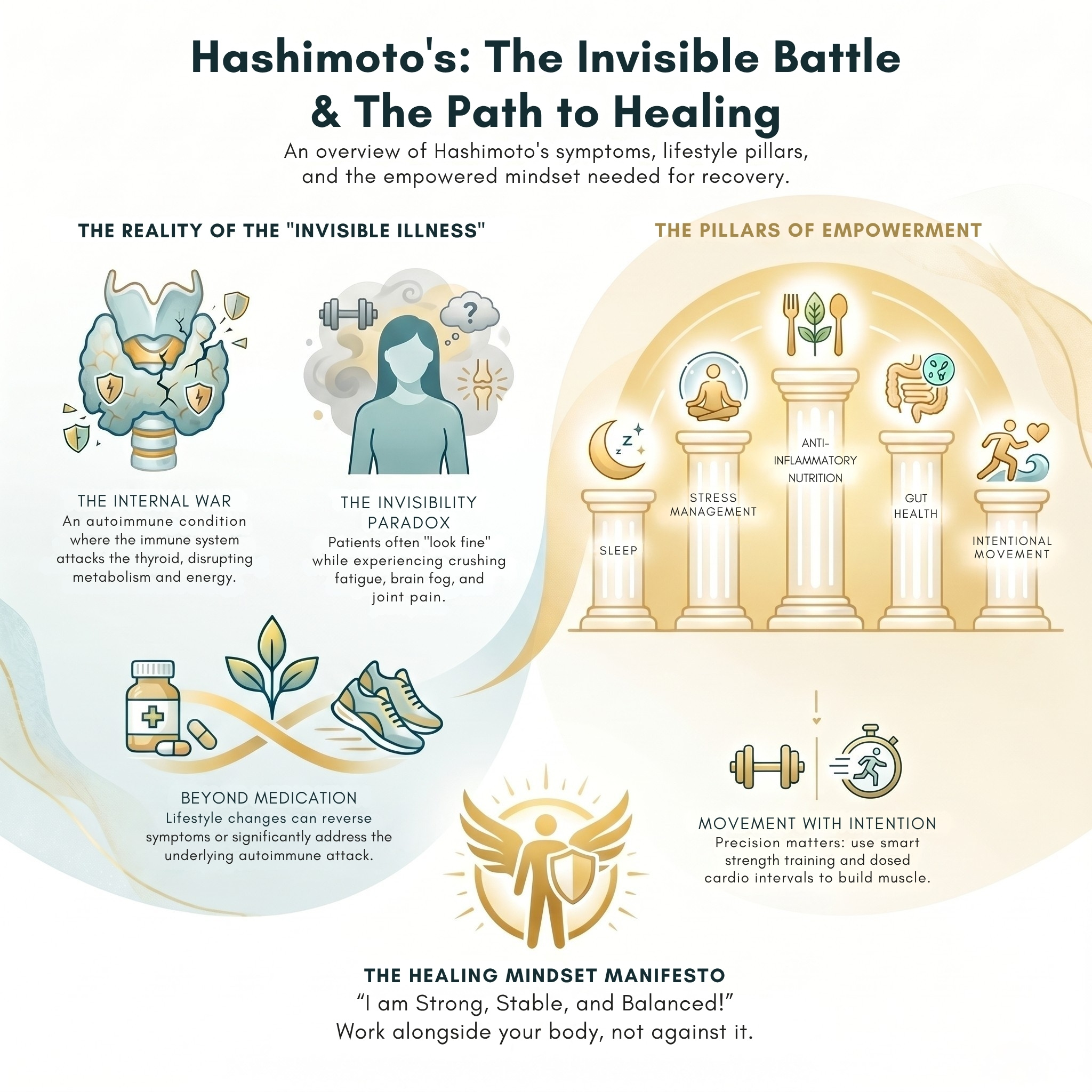
Hashimoto's is an autoimmune condition where your immune system attacks your thyroid gland — the butterfly-shaped organ in your neck that controls virtually every function in your body. Metabolism, energy, mood, temperature regulation, heart rate, digestion — your thyroid touches it all.
It's important to know that Hashimoto's disproportionately affects women: roughly 7 out of 8 diagnosed cases are women, with only 1 in 8 being men. That puts me in the minority — and it's one of the reasons this condition is still so misunderstood, both for men and women: for women because women's health has been under-researched in almost every health aspect, for men because it is a rather rare condition for them. For that reason, in the coming paragraphs I will discuss symptoms, lifestyle impacts, and strategies that relate to both men and women, because regardless of gender, the struggle is real and the path to healing is universal.
But from the outside? You look perfectly normal. And that's the cruelty of it.
- ✦You cancel plans because the fatigue hit like a wall — and people think you're being antisocial.
- ✦You struggle to remember simple words — and people think you're not paying attention.
- ✦You gain weight despite eating well and exercising — and people assume you're not trying hard enough.
- ✦You feel cold when everyone else is comfortable — and people think you're exaggerating.
- ✦Your joints ache, your muscles are stiff, your hair is thinning — but you 'look fine.'
The symptoms: primary and secondary
Hashimoto's doesn't just affect your thyroid. It creates a cascade of symptoms that touch every system in your body. Understanding them is the first step to taking back control.
- ✦Primary symptoms — Chronic fatigue, weight gain, cold intolerance, constipation, dry skin, hair loss, muscle weakness, joint pain, slow heart rate, and depression.
- ✦Secondary symptoms — Brain fog, memory problems, difficulty concentrating, anxiety, irregular periods, fertility issues, high cholesterol, puffy face, and hoarse voice.
- ✦The hidden symptoms — These are the ones rarely discussed: the emotional toll of being disbelieved, the grief of losing your former energy, the frustration of a medical system that often only checks TSH and calls it a day.
Medication is not always necessary — and that changed everything for me
Here's what most people — including many doctors — won't tell you: medication is not always necessary. If you catch the diagnosis early enough, you can reverse the symptoms through lifestyle alone.
I know this because I've done it myself. When I was diagnosed in 2018, after 2 years of severe unexplainable symptoms, my doctors told me my thyroid was 'dead.' They said medication was the only option. They didn't believe it was possible to manage Hashimoto's without it.
But I refused to accept that as my only path. Through deep study, relentless experimentation, and a holistic approach combining anti-inflammatory nutrition, stress management, targeted movement, and mindset work — I reversed my symptoms. Up to today, 8 years later, I have not used any medication. I also guided many people through a similar journey, successfully getting off or lowering their thyroid medication.
Let me be clear: I'm not anti-medication. For many Hashimoto's patients whose condition has progressed significantly, thyroid medication (levothyroxine, liothyronine, or natural desiccated thyroid) is essential and life-changing. But the narrative that medication is the only answer — that lifestyle changes can't make a real difference — is simply not true.
Whether you're on medication or managing through lifestyle, the underlying autoimmune attack on your thyroid still needs to be addressed. That's where lifestyle becomes critical.
The lifestyle pillars that make the difference
Through years of study under leading autoimmunity experts — Dr. Datis Kharazian, Dr. Amy Myers, Dr. Terry Wahls, and Ben Greenfield — and through my own lived experience, I've identified the lifestyle pillars that genuinely move the needle:
- ✦Anti-inflammatory nutrition — Remove the triggers (gluten, refined sugar, processed foods) and add the healers (omega-3 rich fish, turmeric, leafy greens, bone broth). Your gut is ground zero for autoimmune healing.
- ✦Stress management — Chronic stress is gasoline on the autoimmune fire. Daily breathwork, boundaries, and rest aren't luxuries — they're medicine.
- ✦Movement with intention — This isn't just about slow or gentle exercise. It's about well-targeted, carefully dosed training specifically designed for Hashimoto's. That means smart strength training in small, focused sessions to build muscle without overtaxing your system. It means a mix of aerobic work (not too long — endurance sessions need to be measured) and very specific high-intensity cardio intervals. The key is precision: the right type, the right dose, at the right time for your body.
- ✦Sleep as a non-negotiable — 7-9 hours of quality sleep is when your body does its deepest repair work. Protect it fiercely.
- ✦Gut health — Up to 80% of your immune system lives in your gut. Heal the gut, calm the immune response.
The mindset that changed everything
Here's the truth that most health articles won't tell you: all the nutrition, supplements, and lifestyle changes in the world won't work if your mindset is working against you.
When I was diagnosed, I could have let it define me. I could have become 'the sick person.' Instead, I made a choice — the same choice I'd made thousands of times as an athlete: I chose to compete. Not against my body, but alongside it.
My personal manifesto became my anchor:
- ✦Strong — Not in spite of Hashimoto's, but because of what it taught me. Strength isn't the absence of struggle. It's the mental decision to acknowledge that you are a strong and capable person, you just need an adapted path fit to your strengths.
- ✦Stable — Creating consistency in my routines, my nutrition, my sleep, and my mindset. Stability isn't rigidity — it's the foundation that allows flexibility.
- ✦Balanced — Understanding that some days I push, and some days I rest. That both are progress. That balance isn't a destination — it's a daily practice.
What I want you to know
If you're reading this and you have Hashimoto's — or any autoimmune condition — I want you to know this: you are not broken. You are not lazy. You are not imagining it. And you are absolutely not alone.
Your diagnosis is real. Your symptoms are valid. The fatigue, the brain fog, the frustration of being told 'your labs look normal' when you feel anything but normal — all of it is real.
But your future is not written yet. And the pen is in your hand.
The same mindset techniques that carried me through 20 years as an athlete now carry me through life with Hashimoto's. Focus. Visualization. Emotional regulation. Energy management. These aren't just sports psychology concepts — they're survival tools for anyone living with chronic illness.
You don't have to do this alone. And you don't have to figure it all out by yourself.

Nicky Defraeye
Mindset & Health Coach · Hashimoto's Warrior