
If you're living with an autoimmune condition, you've probably felt it: you wait weeks for an appointment, you finally get in… and you have 10–15 minutes to explain something that affects your whole life. This isn't a "doctors don't care" article. It's a reality-of-the-system article. Doctors are essential, especially for diagnosis, monitoring, and medication. But autoimmunity is complex, and complexity needs time. That's where a health coach can become a powerful part of your support team.
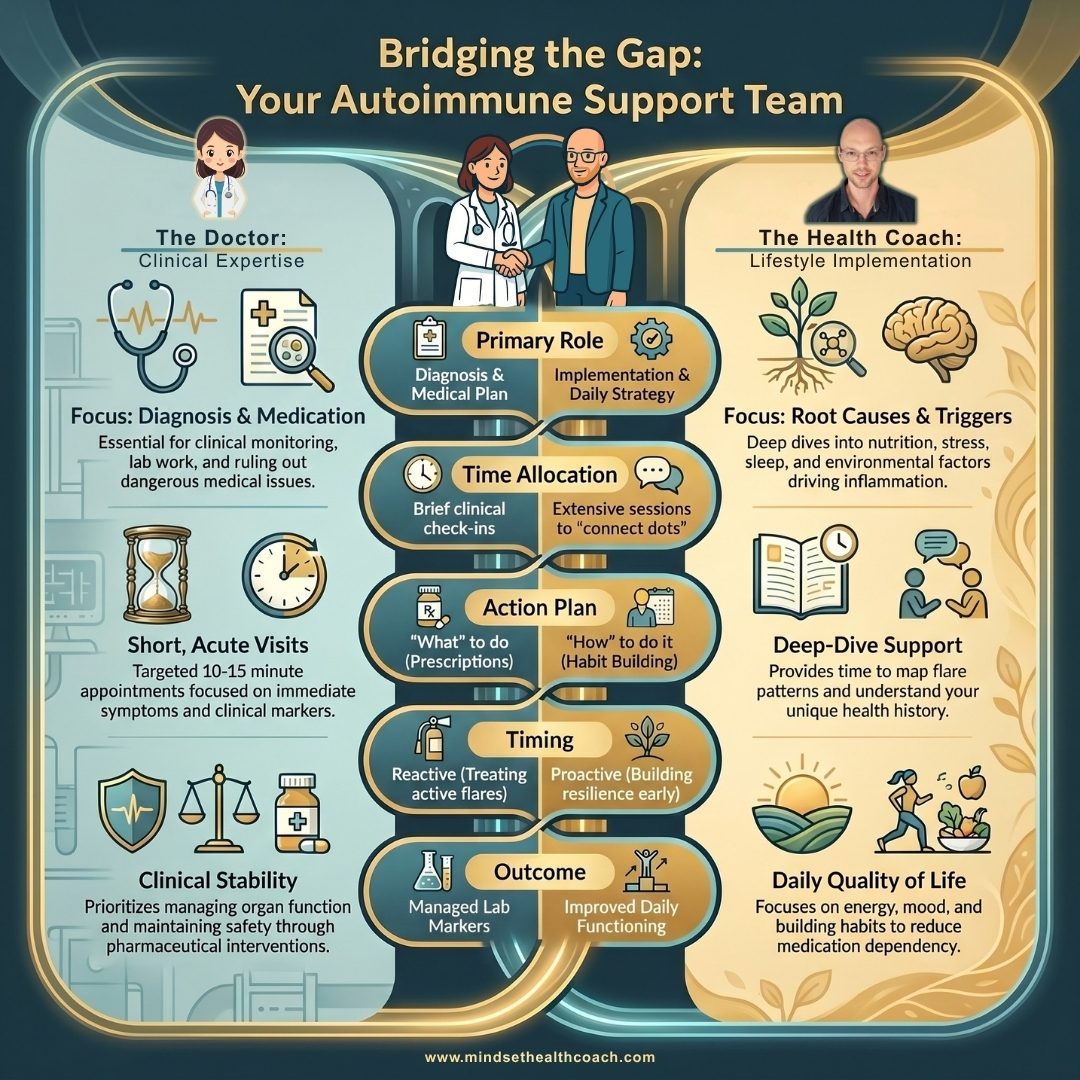
What typically happens in a short doctor's appointment
In many cases, the medical pathway looks like this:
- ✦You notice symptoms and book a visit.
- ✦The doctor asks a few key questions and orders basic blood work (and sometimes more specific tests if symptoms point clearly in a direction).
- ✦Based on results, you receive a diagnosis (or a "watch and wait" approach) and a medical treatment plan.
- ✦Treatment often includes medication, and sometimes referrals (for example physiotherapy).
- ✦And then comes the hard part: you go home with a plan, but with limited time to ask questions, connect dots, or explore what's driving the flare-ups.
The limits of the medical model in autoimmunity (and why they happen)
Autoimmune conditions often don't fit neatly into a quick checklist. Yet the healthcare system is built for efficiency and acute care.
Here are common gaps people experience:
- ✦Lifestyle is often vague or not discussed. Not because it doesn't matter, but because there's rarely time to go deep.
- ✦Triggers aren't fully explored. Stress, sleep debt, food sensitivities, overtraining, under-eating, infections, environmental factors — these can be huge, but they're hard to map in a short visit.
- ✦Symptoms are prioritized over patterns. Many people are treated based on what's loudest right now, not what's been building for months.
- ✦Subclinical situations can be dismissed. Autoimmune markers may be elevated, but if the organ function still looks "normal," you may be told there's nothing to do yet.
- ✦Secondary symptoms may be overlooked. Fatigue, brain fog, anxiety, digestive issues, skin changes, joint pain — these can be life-altering, even when they don't change one key lab value.
- ✦Connections between conditions aren't always discussed. Autoimmune conditions can cluster, and the body doesn't separate systems the way medical specialties do.
What a health coach adds (and why it matters)
A health coach doesn't replace medical care. A good coach complements it by focusing on the parts that require time, context, and day-to-day support.
None of this means "don't see your doctor." It means: don't rely on one role to do everything.
1) Time to listen — and to understand the full picture
Autoimmunity is rarely just "one symptom." It's energy, stress tolerance, digestion, sleep, mood, training response, cycle changes, cravings, pain, recovery, and more.
A coach has the time to explore:
- ✦Your history and timeline (when things started, what changed)
- ✦Your daily routines and stress load
- ✦Your flare patterns and early warning signs
- ✦What you've tried, what worked, and what backfired
2) Root causes and triggers become the main focus
Doctors often have to focus on diagnosis and treatment. Coaches can focus on what's driving inflammation and dysregulation in your day-to-day life.
That includes:
- ✦Nutrition and blood sugar stability
- ✦Movement that supports recovery (not just "more exercise")
- ✦Sleep quality and nervous system regulation
- ✦Mindset, boundaries, and stress management
- ✦Deficiencies and basic foundations (hydration, protein, micronutrients)
3) You don't have to wait for things to get "bad enough"
Autoimmune markers matter. They can be a sign that the immune system is active, even if symptoms are mild or organ function is still in range.
A coach can help you treat this phase as a window of opportunity:
- ✦Build anti-inflammatory habits early
- ✦Reduce flare frequency and intensity
- ✦Improve resilience so your body handles stressors better
4) Translating medical advice into real life
"Take this medication" is clear.
But "reduce stress," "eat healthier," or "sleep more" can feel impossible without a plan.
A coach helps you turn broad advice into doable steps:
- ✦What to change first (and what to leave alone for now)
- ✦How to build routines that fit your energy and schedule
- ✦How to track progress without obsessing
- ✦How to adjust when life happens
5) Medication is respected — but lifestyle reduces dependency
Medication can be life-changing and sometimes life-saving. The goal isn't to shame it.
The goal is to support your body so medication becomes one pillar, not the only pillar.
With consistent lifestyle interventions, many people experience:
- ✦Fewer flare-ups
- ✦Better energy and mood
- ✦Improved digestion and recovery
- ✦More stable daily functioning
- ✦And in some cases (always in collaboration with the prescribing physician), that can contribute to reduced dosage needs over time or even getting off medication is sometimes possible.
The best outcomes happen when doctor + coach work as a team
Think of it like this:
- ✦Your doctor is essential for diagnosis, medical monitoring, prescriptions, and ruling out dangerous issues.
- ✦Your health coach is essential for implementation, lifestyle foundations, root-cause exploration, and ongoing support.
Autoimmunity is not just a lab result. It's a lived experience.
When you combine medical care with coaching, you get both:
- ✦The safety and expertise of clinical medicine
- ✦The depth, time, and personalization of lifestyle-based support
- ✦A sustainable long-term plan for a healthier mind and body
A gentle note: this is not medical advice
This article is educational and supportive. It does not replace medical care. If you suspect an autoimmune condition or your symptoms are worsening, always consult a qualified healthcare professional.
If you're in that "I don't know where to start" phase
If you've been told "your labs are fine" but you don't feel fine, or if you've been diagnosed and you're overwhelmed by what to do next, coaching can help you create a clear plan.
You deserve more than a quick appointment and a lifetime sentence.
You deserve a strategy, support, and a path forward — one step at a time.
In some cases, this can make a big difference, between lifelong medication and no medication at all, because you treat the inflammation while the organ attacked still functions properly.

Nicky Defraeye
Mindset & Health Coach · Hashimoto's Warrior